
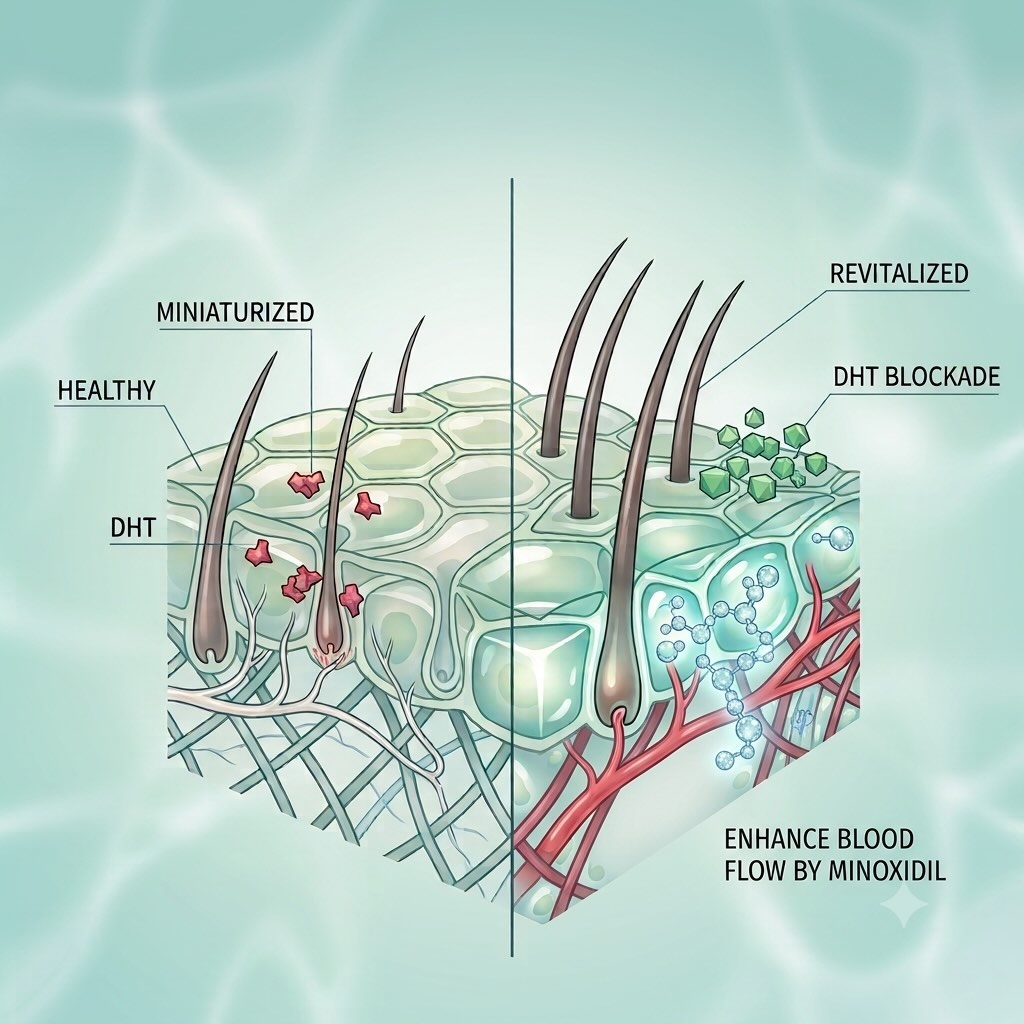
Androgenetic alopecia (AGA) affects a majority of men and a large share of women over a lifetime, yet it is routinely dismissed as cosmetic. That framing does patients a disservice: the psychological burden of progressive hair loss is real and well documented, and the underlying biology is a genuine, treatable endocrine-dermatological process.
A condition of genetics and androgens
AGA is driven by a genetic predisposition that renders scalp follicles sensitive to dihydrotestosterone (DHT), the potent androgen produced from testosterone by 5-alpha reductase. In sensitive follicles, DHT progressively shortens the growth (anagen) phase and miniaturises the hair shaft over successive cycles — terminal hairs give way to fine, barely-pigmented vellus hairs, and eventually to none at all.
The pattern is characteristic: a receding frontal hairline and vertex thinning in men, and a diffuse widening of the central part with a preserved frontal line in women. Recognising it early matters, because every therapy we have works better at preventing loss than at regrowing what is already gone.
The evidence-graded ladder
Topical minoxidil and oral or topical finasteride remain the two best-evidenced pharmacological interventions. Minoxidil, originally an antihypertensive, prolongs anagen and increases follicular blood supply; finasteride and dutasteride reduce DHT by inhibiting 5-alpha reductase. Around these sit low-level laser therapy and platelet-rich plasma, with a growing but more heterogeneous evidence base.
The most useful lesson from recent reviews is not a new molecule but a shift in emphasis: adherence and early intervention determine outcomes more than the choice between well-established agents. A therapy the patient tolerates and continues for years beats a marginally more potent one they abandon in three months.
Where topicals now sit
For years the debate pitted topical against systemic therapy. The current view is more pragmatic — they are complementary. Topical delivery keeps the active where it is needed and minimises the systemic exposure that drives fear of side effects, the most common reason men stop treatment. That is exactly the problem vehicle design is meant to solve: get the molecule to the follicle, keep it there, and make the routine something a patient will actually keep up.