
Xhealth Products | News & Insights Category: Hair Health | Reading time: ~4 minutes
Hair loss is one of the most common conditions in the world — yet for millions of people, it remains deeply misunderstood, undertreated, and a source of genuine psychological distress. In 2025, one of science’s most respected journals published a comprehensive review of androgenetic alopecia (AGA) in Nature Reviews Disease Primers, offering the clearest, most authoritative picture yet of what causes hair loss, who it affects, and what today’s treatments can realistically achieve. Here is what it means for patients and clinicians in Greater China.
What Is Androgenetic Alopecia?
AGA — commonly known as male or female pattern hair loss — is the most prevalent form of non-scarring alopecia globally. The Nature Reviews Disease Primers 2025 review, authored by an international team from UC Irvine, University of Miami, National Taiwan University, Seoul National University, and other leading institutions, describes AGA as a condition driven by the interplay of genetic predisposition and androgen signalling, primarily through dihydrotestosterone (DHT).
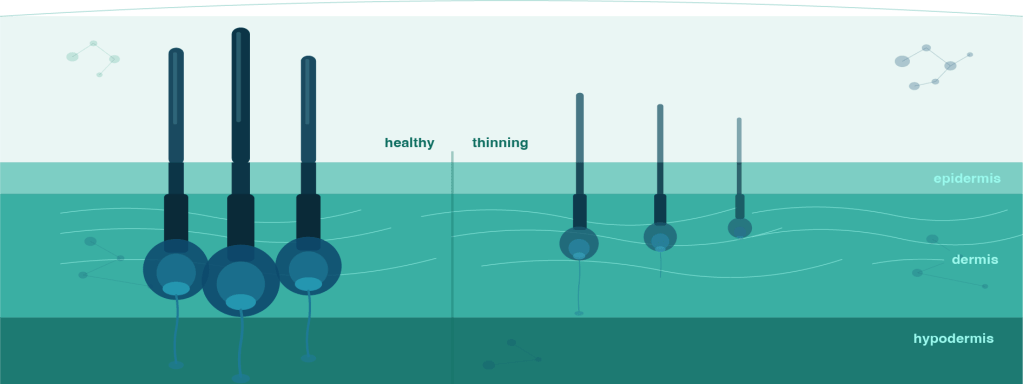
In genetically susceptible individuals, DHT binds to androgen receptors in hair follicle dermal papilla cells, triggering a cascade that progressively shortens the hair growth (anagen) phase and miniaturises the follicle. Over time, thick terminal hairs are replaced by fine vellus hairs — the hallmark of pattern hair loss.
Critically, the 2025 primer emphasises that AGA is not a cosmetic inconvenience. Multiple studies confirm it is associated with significant psychological burden — including anxiety, depression, and reduced quality of life — particularly among younger patients and women.
Who Does It Affect?
AGA affects both men and women, though clinical presentation differs. In men, the classic Norwood-Hamilton pattern of frontal recession and vertex thinning is well recognised. In women, diffuse thinning over the crown (Ludwig pattern) is more typical, often without a receding hairline.
The condition is highly prevalent in Asian populations. Epidemiological data show that AGA affects approximately 30–40% of Chinese men by age 40, with prevalence rising with age. Female AGA is also substantially underdiagnosed in China, where cultural stigma and limited awareness delay treatment-seeking. The earlier treatment begins, the better the outcome — follicle miniaturisation, once complete, is irreversible.
What Drives Hair Loss at the Molecular Level?
The Nature Reviews Disease Primers review provides an updated framework for understanding AGA pathogenesis. Beyond androgen metabolism, emerging evidence implicates:
- Inflammation and fibrosis around the hair follicle, even in early-stage disease
- Impaired energy metabolism within follicle dermal papilla cells
- Prostaglandin imbalance — elevated PGD₂ (inhibitory) and reduced PGE₂ (stimulatory) in balding scalp
- Genetic architecture — genome-wide association studies have identified more than 600 susceptibility loci, with the androgen receptor gene on the X chromosome remaining the strongest single signal
This multi-pathway model explains why no single drug eliminates AGA entirely — and why combination therapy is increasingly recommended.
What Does the Evidence Say About Treatment?
Minoxidil and finasteride remain the only two pharmacological treatments with robust, long-term evidence — and both are endorsed as first-line therapy by international dermatology guidelines.
A 2022 network meta-analysis published in JAMA Dermatology (Gupta AK et al., 2022;158(3):266–274) compared the relative efficacy of minoxidil against 5-alpha reductase inhibitors across multiple RCTs. The analysis confirmed that topical minoxidil produces clinically meaningful gains in total and terminal hair density at 24 weeks, with a favourable safety profile when applied directly to the scalp.
Finasteride works through a complementary pathway — inhibiting the conversion of testosterone to DHT at the follicle level — making combination therapy more potent than either agent alone. A growing body of RCT evidence, including a 2025 meta-analysis in Frontiers in Medicine (Li et al.) of seven trials across five countries, confirms that minoxidil plus finasteride combination produces superior hair density outcomes compared to minoxidil monotherapy.
Emerging treatments — including platelet-rich plasma (PRP), low-level laser therapy, exosome-based therapy, and JAK inhibitors — show early promise in the 2025 Nature primer but require further large-scale trial data before they can be considered standard of care.
Why Early, Consistent Treatment Is the Key Message
Perhaps the most important clinical insight from the 2025 Nature Reviews Disease Primers is this: AGA is a progressive condition, and treatment efficacy depends on intervening before follicle miniaturisation becomes irreversible. Patients who begin treatment in the early stages, and maintain it consistently, achieve meaningfully better outcomes than those who wait.
For clinicians in Greater China, this means proactively discussing AGA with patients presenting early — particularly younger men with a family history of hair loss. For patients, it means understanding that hair loss is not inevitable, and that evidence-based options exist.
Xhealth’s Commitment to Evidence-Based Hair Health
At Xhealth Products, our hair care portfolio is built on the same science that underpins the international guidelines. Xcare® Minoxidil Cutaneous Foam 5% delivers minoxidil directly to the scalp via a lightweight, fast-drying foam formulation clinically proven to stimulate follicle activity and promote hair regrowth. XGaine™ Finasteride 2.275 mg/ml Cutaneous Spray Solution provides targeted scalp delivery of finasteride — offering the efficacy of 5-alpha reductase inhibition with minimised systemic exposure.
Together, they represent a combination approach grounded in the evidence. Because when science advances, so does our commitment to your patients and their hair health.
Speak to your dermatologist or contact Xhealth Products for more information about our hair health solutions.
References
- Liu Y., et al., Nat Rev Dis Primers. 2025;11(1)73. https//doi.org/10.1038/s41572-025-00656-9
- Gupta AK., et al., JAMA Dermatol. 2022;158(3)266–274. https//doi.org/10.1001/jamadermatol.2021.5743
- Li et al. Front Med (Lausanne). 2025;121632139. https//doi.org/10.3389/fmed.2025.1632139
This article is intended for educational purposes. It does not constitute medical advice. Patients should consult a qualified healthcare professional before starting any treatment.
 Xhealth Products Ltd